


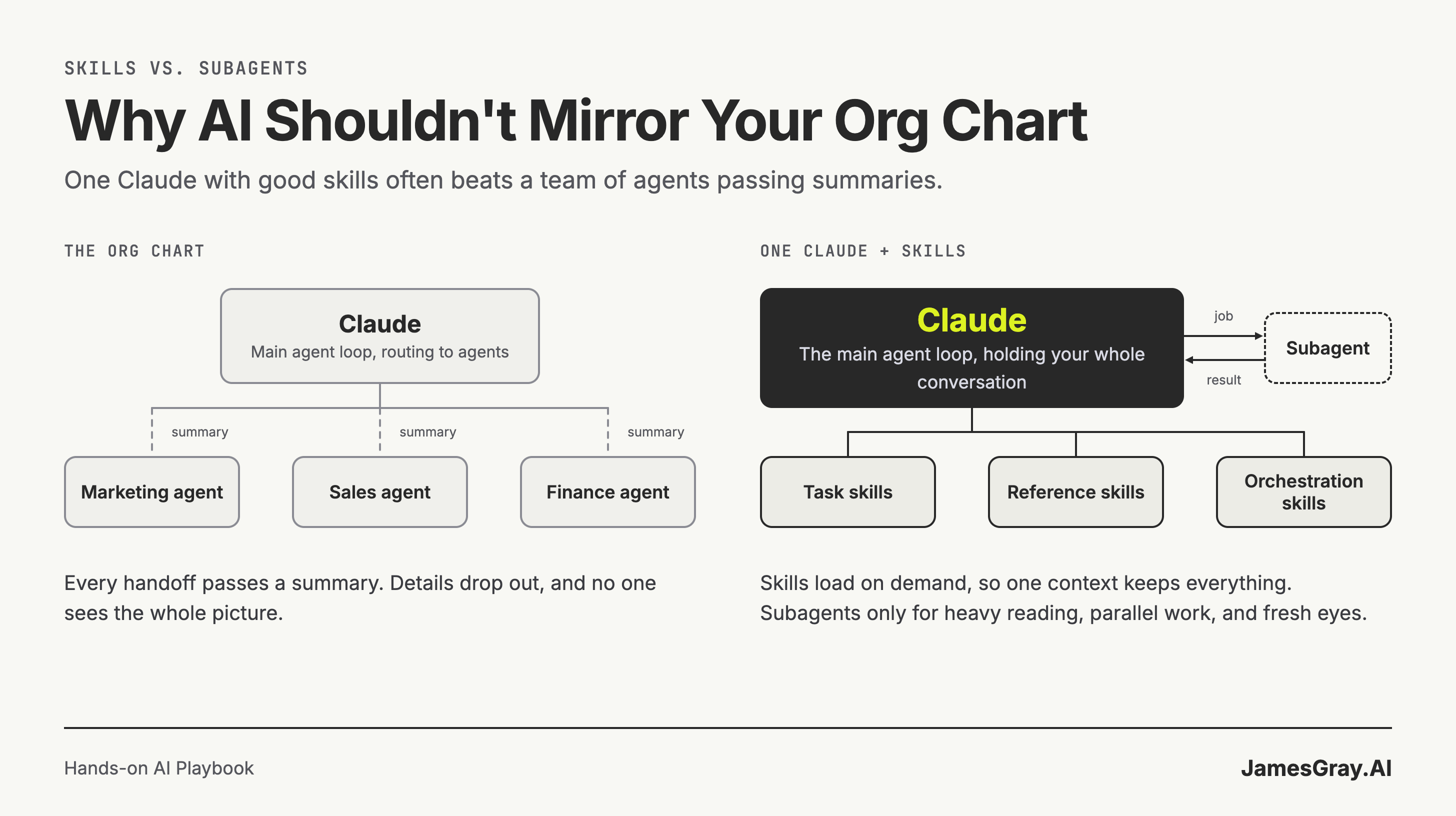
When to use subagents, and when one Claude with good skills does the job better
TL;DR
Just use Claude. Anthropic found that a single agent with skills often beats a team of subagents. For you, that agent is Claude itself.
Splitting work costs context. A subagent is handed a job and a summary. It never sees the full picture.
Use a subagent for three jobs: heavy reading, parallel work, and fresh-eyes review.
Everything else is a skill. Task, reference, and orchestration skills cover most business work.
The test: does this work need to know what we’ve been discussing? If yes, it’s a skill.
You open Claude and set up a team. A marketing agent, a sales agent, a finance agent. Maybe an operations agent to tie it all together.
It feels like good management, but it’s usually the wrong AI design.
This week Anthropic published guidance from its Applied AI team on folding subagents back into the main agent. Across several enterprise deployments, a single agent with skills often beat multi-agent designs in quality. It also cost less and ran faster.
That single agent already exists. It’s Claude, the one you use every day. Your job is to give it great skills.
Anthropic’s article targets developers building production agents. But the lesson applies to every leader setting up Claude for their team. Here’s how I’m teaching it.
First, the key terms
Claude is already an agent. When it searches the web, reads your files, or uses a connector, it’s acting as an agent. You don’t need to build a separate agent first.
The main agent loop is how that works. Claude reads the context, picks a tool, checks the result, and decides the next step. It repeats until the job is done.
A subagent is a second Claude the main one sends off on a task. It gets its own fresh context, does the work, and sends back a summary.
So for anything you set up in Claude, the real decision is narrower: should it be a skill or a subagent?
A skill is a playbook. It tells Claude how your team does something. Claude loads it when relevant.
A subagent is a contractor. Claude sends it out to do a separate job and report back.
Think about your next board update. You’d hand your chief of staff the template, because they already know the context. You wouldn’t send it to an outside writer who missed every meeting that shaped it.
The template is the skill. Your chief of staff is Claude, with the full context of your conversation. The outside writer is the subagent: capable, but starting cold.
Skills come in three types:
Task skills teach Claude how to do one job well, every time. Drafting a proposal, scoring a lead, writing a board update.
Reference skills give Claude what it needs to know. Your brand voice, pricing rules, product specs, policies.
Orchestration skills run an end-to-end workflow. They sequence the steps and call on task and reference skills along the way.
Why the org chart design breaks
Systems tend to mirror the organizations that build them. That’s Conway’s law, and Anthropic sees it often in enterprise agents. Each team gets its own agent, and the architecture ends up mirroring the org chart.
Three things go wrong:
Context gets lost. Each subagent sees only what you pass it. Details drop out at every handoff, like a game of telephone.
Instructions conflict. Every team adds its own rules. Anthropic calls the result a “Frankenprompt.”
Speed suffers. Each handoff is another model running its own loop. One customer saw roughly 2x faster runtime after moving to a single agent.
The higher cost is insight, because one Claude that saw every step can connect the dots in ways a stack of summaries can’t.
Leader Lens
Dividing work by function is a sound management habit for people, but it transfers poorly to AI. Older models needed tasks broken up and handed to specialists. Since Opus 4.5, models plan, check their own work, and handle far more in one loop.
So the leadership question shifts from “who owns this agent?” to “who owns the playbook?” Let teams own their skills, and keep one owner for how Claude works overall.
Why one Claude can handle more now
The old reason to split work was overload. Load every playbook and tool up front, and Claude wades through instructions it doesn’t need for the task at hand.
The answer is called progressive disclosure. It means Claude gets information in stages, only when a task needs it. Think of how a good team onboards a new hire. On day one, they get a list of the playbooks that exist, and they open a specific one only when the work calls for it.
Claude handles skills the same way. It sees a one-line description of each skill and reads the full playbook only when a task needs it. Tools work the same way through a feature called tool search: Claude sees tool names and pulls up the full details only when it’s about to use one.
In Claude’s apps, this happens automatically. You can connect many skills and tools without slowing Claude down. Anthropic cut Claude Code’s system prompt by over 80%, partly by doing this.
The trade-off is that Claude can only pick the right skill if its description is clear. Vague or overlapping descriptions can confuse two skills. A one-line description that names when to use the skill is worth the extra minute.
When a subagent earns its place
Anthropic’s article reserves subagents for specific jobs. Translated for business work, there are three.
1. Too much reading. The task would flood your conversation with material you’ll never look at. Example: “Review these 50 customer interviews and return the top five themes.”
2. Parallel work. Several independent jobs can run at once, each with fresh context. Example: “Research these six competitors’ pricing at the same time.”
3. Fresh eyes. You want a reviewer who didn’t produce the work. Example: “Critique this proposal as a skeptical CFO who hasn’t seen my draft.”
If none of these apply, it’s probably a skill.
The one-question test
Ask this about any task:
Does this work need to know what we’ve been talking about?
Yes: keep it in the main conversation. Capture the know-how as a skill.
No, I just want the answer back: it’s a subagent candidate.
For most business work, the answer is yes. Proposals, analysis, planning, and writing all depend on shared context, and one Claude keeps it intact.
Try this (10 minutes). List any subagents, projects, or saved instructions you’ve set up in Claude. Run each one through the test: should it be a skill or a subagent?
Skills first, agents second
This is why my cohorts spend a full week, and then some, on skills before we touch agents. That week is often where leaders get the most value.
My guidance, in my courses and with every leader I advise, is the same. Start by building skills for your specialized tasks, and get the most out of them before anything else. Skills are where your unique expertise lives. They’re how you package what you know so Claude can use it every time.
Writing a skill also asks you to do something. You have to put into words how you actually do the work: the steps, the judgment calls, the standards. It requires the same clarity as good delegation to people.
In my experience, these three skill types cover a surprising amount of work, and orchestration skills carry the most weight. One orchestration skill gives you much of what people expect from a multi-agent system. You get a coordinated, multi-step workflow without a single handoff.
Once you’ve built a few of each, add subagents only for the three jobs above.
The 15-minute sorting exercise
I use this with leaders in my cohorts. It works best with tasks from your real calendar.
List five to seven recurring tasks from your actual week.
Is it a procedure, reference, or multi-step workflow? Make it a task, reference, or orchestration skill.
Is it heavy reading, parallel, or a review? It’s a subagent candidate.
Neither? Ask Claude directly. No special setup needed.
Expect most of your list to land in steps 2 and 4.
Keep what holds up
Anthropic’s closing advice is simple discipline: measure, change one thing at a time, and keep what works.
Applied to your setup, that means one rule. Before building a new agent, try the task with one Claude and a good skill. Add a subagent only if the result is clearly worse without it.
So over the next two weeks, take the top orchestration skill from your sort, build it, and run it on real work at least three times.
Once you’ve run the sort, post your top orchestration-skill candidate in the comments. Seeing which workflows other leaders pick is one of the fastest ways to spot your own.
Source: Building agents: When to fold subagents into your main agent loop, Diane Sarkis, Anthropic, October 22, 2026.
A worked example from my course
If you’d like to see it all working together, here’s the example I use in class. In my Build Agentic Workflows with Skills lesson, I teach this framework with one worked example: the Opportunity Decision Brief. You hand Claude a business idea, and it returns a researched go, refine, or no-go recommendation for you to weigh.
It’s the whole post in one workflow. An orchestration skill does the coordinating. Four research subagents work in parallel, and a fifth writes the brief. You make the final call. (My next two cohorts start November 9.)
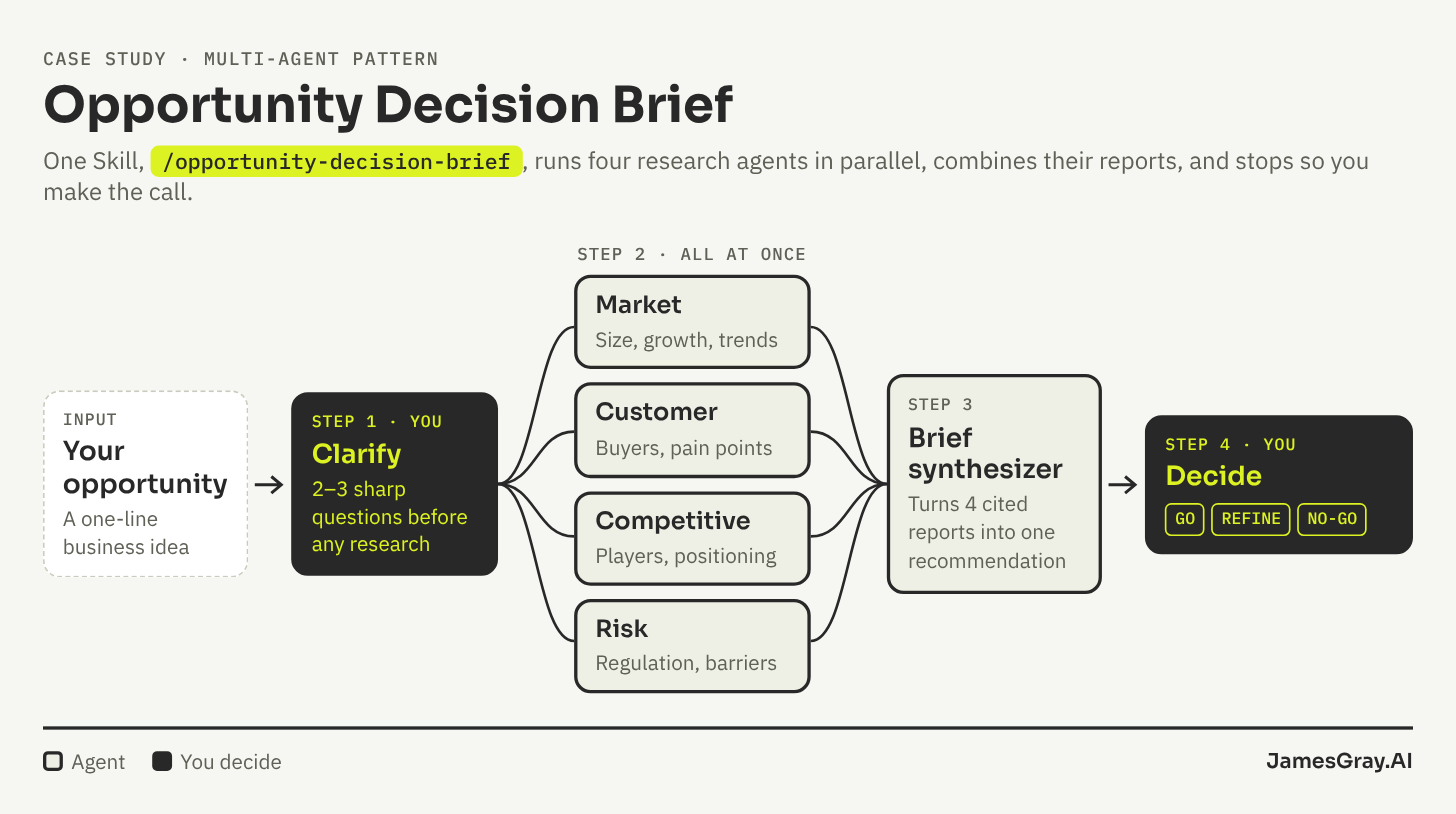
Opportunity Decision Brief workflow diagram: you clarify the idea, four research subagents work in parallel, a synthesizer writes the brief, and you decide
The dark boxes are where you stay in charge: clarifying the idea at the start and making the decision at the end. Everything in between is Claude’s work.
Below the line for paid subscribers:
The full worked example: how the skill and its five subagents fit together, mapped to the one-question test
The six design choices worth copying into your own orchestration skills
The one piece I’d test folding back into the main Claude, and how to run that test
The installable files, with setup steps for Claude and Claude Code
How to adapt it for decisions in your own business
