


The leaders I work with don’t lack intelligence, ambition, or opportunity.
They lack discipline.
Not the grind-it-out, white-knuckle willpower kind. The deeper kind: the discipline to say no. To set boundaries. To stop blaming circumstances for outcomes they created.
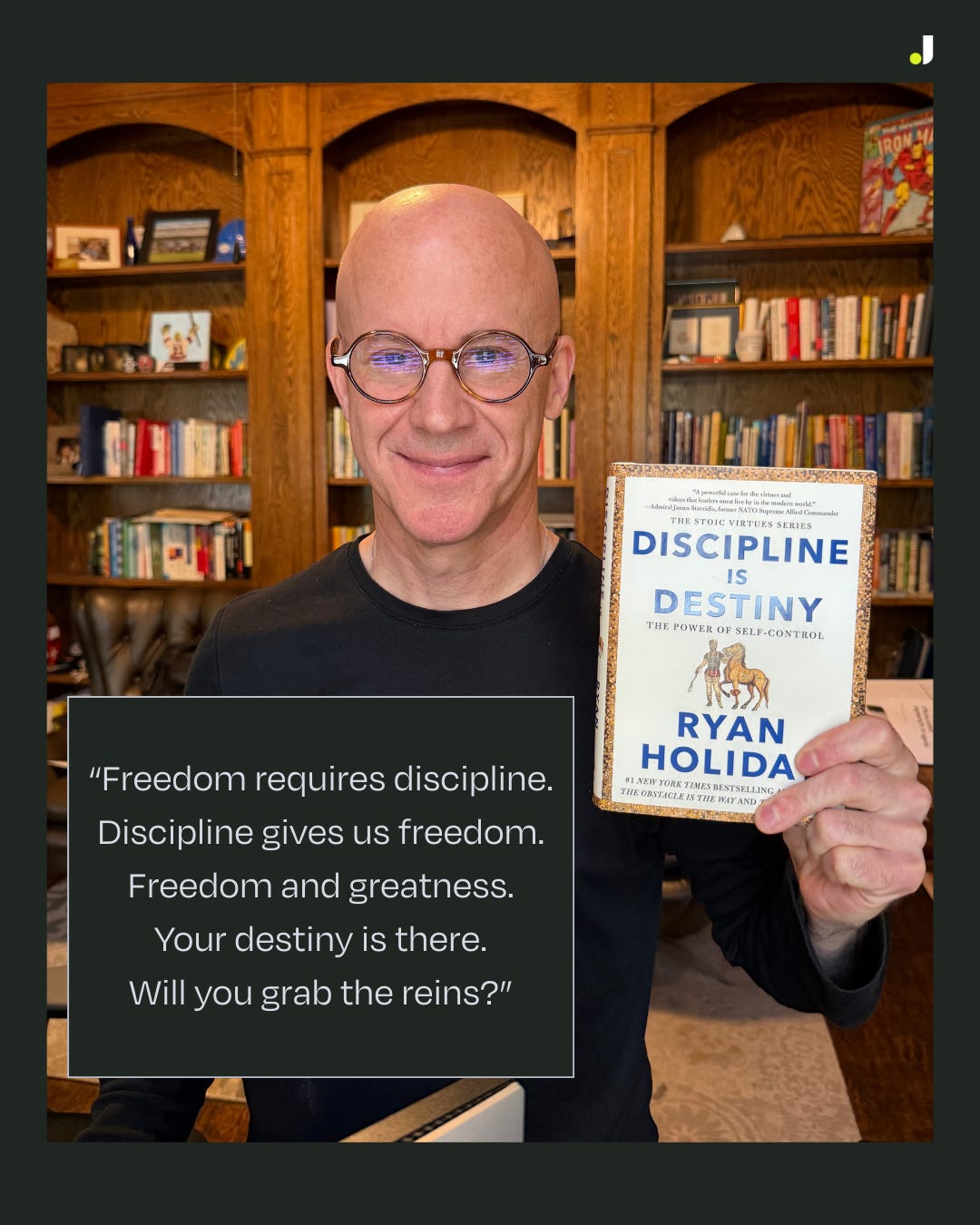
I first read Ryan Holiday’s Discipline is Destiny back in 2022. This week, I picked it up again.
Not because I forgot what it said. Because discipline is a muscle that atrophies. In a world changing as fast as ours—where AI reshapes industries monthly and the skills that mattered yesterday become table stakes tomorrow—self-control isn’t a one-time achievement. It’s an ongoing practice. The foundation for mastering whatever craft you’re building.
So I returned to the text. And it hit differently this time.
Here’s what landed hardest.
The Freedom Paradox
We think discipline restricts us. Holiday argues the opposite:
“The less you desire, the richer you are, the freer you are, the more powerful you are. It’s that simple.”
Read that again.
Freedom isn’t getting everything you want. It’s wanting less. It’s having the discipline to release what doesn’t serve you—the status chase, the approval seeking, the reflexive yes.
“Discipline is how we free ourselves. It is the key that unlocks the chains... We choose the hard way because in the long run, it’s actually the only way.”
The chains aren’t external. They’re the habits, vices, and patterns we’ve surrendered to. Discipline doesn’t lock you in. It lets you out.
Control What’s Controllable
Here’s the uncomfortable truth about most of what frustrates you: it’s outside your control.
The economy. Your board. Your competitors. Your boss’s moods. Market timing.
But Holiday points to something that’s always within reach:
“Life is filled with all sorts of difficulties and challenges. Work will not always go well. But working out? Working out is in our control. It is a contained space in which the only potential obstacle is our determination and commitment.”
Working out isn’t just about fitness. It’s a metaphor for any practice you control completely: your morning routine, your reading habit, how you show up to the first meeting of the day, whether you respond or react.
And here’s the kicker:
“We don’t rise to the occasion, we fall to the level of our training.”
That crisis moment you’re worried about? You won’t suddenly find discipline when it arrives. You’ll default to whatever you’ve been practicing. If you’ve been practicing distraction, reactivity, and avoidance—that’s what shows up under pressure.
The Space Between
I kept coming back to this one.:
“We know that between every stimulus and its response, every piece of information and our decision, there is a space. It is a brief space, to be sure, but one with room enough to insert our philosophy. Will we use it?”
That space is everything.
It’s where you decide whether to fire off the angry Slack message or sleep on it. Whether to say yes reflexively or pause and ask what you’re actually committing to. Whether to scroll for another hour or close the laptop and be present.
If you’re using AI tools, this space matters even more. The prompt you write in that moment—reactive or intentional—shapes everything that follows. AI amplifies whatever you bring to it. Bring discipline, get leverage. Bring chaos, get noise.
But most of us collapse that space. We react before we think. We say yes before we count the cost.
“It is impossible to be committed to anything—professionally and personally—without the discipline to say no to all other superfluous things.”
“Everything we say yes to means saying no to something else. Every no can also be a yes, a yes to what really matters.”
“No one can say yes to their destiny without saying no to what is clearly someone else’s. No one can achieve their main thing without the discipline to make it the main thing.”
Your calendar reveals your discipline. Your commitments reveal your boundaries—or lack of them.
Sharp Begets Sharp
Holiday offers a line that sounds almost circular until you sit with it:
“We look sharp to stay sharp, to be sharp... because we are sharp.”
Identity precedes action. You don’t become disciplined by occasionally acting disciplined. You become disciplined by deciding you are disciplined—and then living into that identity every day.
“But that’s what the greats do, they don’t just show up, they do more than practice, they do the work.”
Showing up is minimum viable effort. The greats do the extra rep, the additional revision, the unglamorous preparation no one sees. They don’t wait for motivation. They work.
What I Had to Learn the Hard Way
I’ll be honest: discipline hasn’t always been my strength. And even now, it’s something I have to maintain actively.
For years, my pattern was saying yes to everything. Yes to the extra project. Yes to the meeting that should have been an email. Yes to requests that served someone else’s agenda at the expense of my own energy and focus.
I told myself I was being helpful. Collaborative. A team player.
The truth? I was avoiding conflict. I lacked the discipline to set boundaries—at work, in relationships, in how I protected my time.
It wasn’t until I read Boundaries by Henry Cloud that the real lesson landed: my lack of boundaries wasn’t other people’s fault. It was my lack of responsibility and conviction. I had been blaming external pressures for problems I had created by never saying no.
That was hard to accept.
But it was also the most empowering realization of my life. Because if I created the problem, I could fix it. The boundary wasn’t someone else’s to set. It was mine.
Three years ago, when my CIO role ended, I faced a choice. Chase the next title immediately—say yes to the first opportunity that validated my ego—or sit in the discomfort and ask what I actually wanted to build.
I chose the harder path. I chose discipline over distraction. To sit with my discomfort, and answer the question of what I wanted to say “yes” to. That discipline is what created everything I do today.
But here’s what I’ve learned since: you don’t build discipline once and move on. You rebuild it constantly. The muscle atrophies. Old patterns creep back. That’s why I return to books like Holiday’s—not for new information, but for renewed commitment.
Your Turn: The Discipline Audit
This week, I’m challenging you to stop explaining and start owning.
1. Name what controls you. What habit or vice has more power over you than you have over it? The reflexive yes? The doom scroll? The extra drink? Avoiding hard conversations? Write it down. No rationalizing.
2. Own your outcomes. Here’s the uncomfortable truth: your lack of discipline has delivered many of the negative results in your life. Not your boss. Not the economy. Not your circumstances. You.
Can you say that out loud without flinching?
3. Identify one boundary to set. Where have you been saying yes at your own expense? What conversation have you been avoiding? This week, set one boundary. Enforce it.
4. Inspect ruthlessly. For the next seven days, audit your decisions. Where does discipline break down? What triggers the collapse of that space between stimulus and response? What one change will you commit to starting Monday?
The bottom line: Self-discipline is within your control. Master it before it masters you.
I’ll be running this audit on myself this week, too. If you’re willing to share what you discover, hit reply. I read every response.
Stay curious,
James