


We spend our lives studying everything except the one subject that matters most.
We master tools, markets, and frameworks. We refresh the feed. We chase the next topic, the next thread, the next opinion someone else decided was urgent. Most of it is noise dressed up as learning, a comfortable distraction from the only study that sets the direction of a life.
The most important subject you will ever study is yourself.
This is a discipline, not a slogan. The strength of your self-awareness guides you toward purpose and enables you to bring your unique capabilities to bear on the world. And almost no one is doing the work. We’ll read books about other people, or scroll through Instagram, before we sit quietly with ourselves and ask the questions that change anything.
I’ve been circling this since 2008
Back then I hosted career-strategy workshops at Microsoft. What struck me was how few people had an internal compass that was calibrating and guiding their direction. It was a realization that kept surfacing: we needed to discover our own values, our own expertise, and how we wanted to grow as individuals, regardless of the role we happened to hold at that moment.
The opportunity in front of you is temporary. The questions underneath it are not. Who are you? Who do you want to become? Where does your particular expertise belong?
That fascination wasn’t academic for me. It carried me through one of the hardest chapters of my life, the season when a job ended and I felt lost. What steadied me had nothing to do with a title. It came from turning inward, from trusting I could discover who I was apart from any single role. Self-awareness was the compass when the map disappeared.
Collins calls them “encodings”
This past week I read Jim Collins’s What to Make of a Life. It put words to something I’ve been circling for years.
Collins calls our unique qualities encodings. He defines them as “durable capacities of a person’s intrinsic construction that lie within, awaiting discovery through the experiences of life.” Sit with that last phrase: awaiting discovery. You don’t invent or construct your encodings. You uncover what is already in you.
“You don’t create encodings, you discover them. You don’t add encodings from without, you find them within.”
This is the part most of us get backward. We treat our future selves as something to be built: more skills, more credentials, more bolted on from the outside. Collins says the most important things are already there, fixed, waiting. The work is less about adding to yourself and more about digging out what is already in you.
And discovery is only half of it. He poses the question I haven’t been able to put down:
“Which encodings will the journey of life lead you to discover, and will you entrust them enough to align your life around them?”
Discovering your encodings is one thing. Trusting them enough to organize a life around them is another entirely. There will be seasons of self-doubt, moments when the safe path beckons, when following the crowd feels like the responsible choice. But your true calling announces itself differently. It’s the energy you feel when you apply your encoding in a way that is natural and entirely yours.
A constellation, and a frame

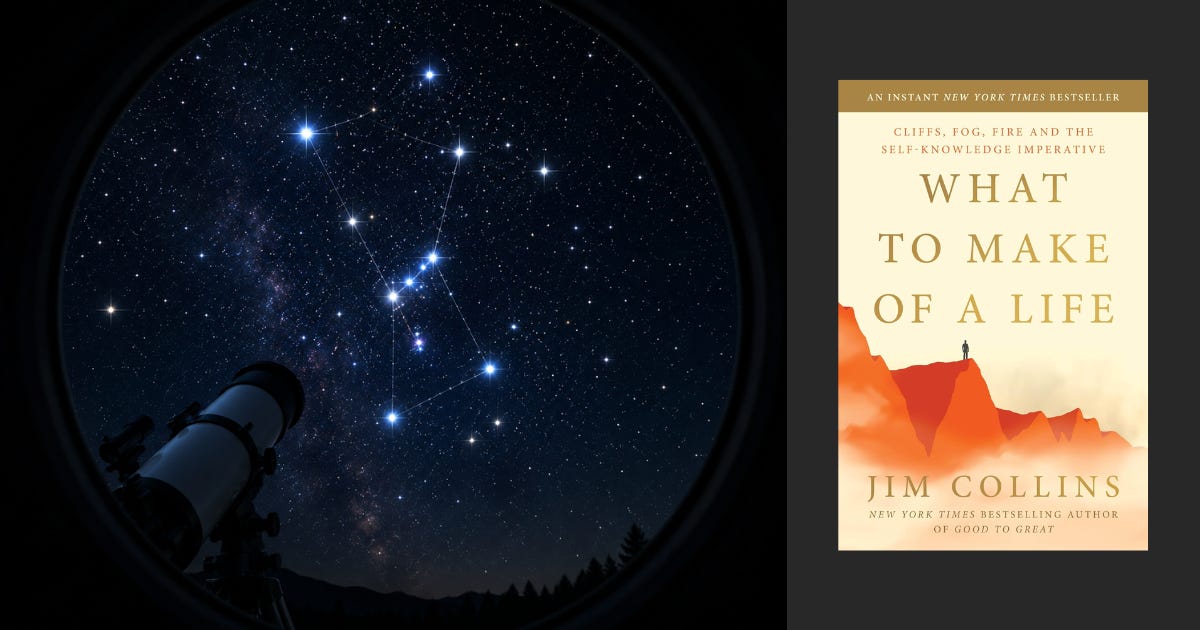
Collins offers an image I keep returning to.
“Picture a constellation of stars. Now imagine looking through a frame that limits how much of the constellation you can see, such as looking through the lens of a telescope or camera. Stars outside the frame remain hidden, while those inside the frame shine brightly through the lens.”
The encodings are fixed. Like the stars, they don’t move. What changes as you move through life is the frame: where it points, how wide it opens, and whether a bright cluster of your encodings happens to sit inside it.
So much of self-discovery is patiently adjusting that frame until what was always there comes into view.
How to see your stars: the bug book
So how do you bring the constellation into the frame?
Collins did it with what he called a bug book. To learn about himself, he carried a notebook everywhere and took notes throughout the day, trying, in his words, to be a scientist of the self. He tracked the moments that lit him up and the ones that drained him. And in that book he discovered his own encoding: a gift for packaging and teaching ideas in a way that sticks.
I love this because it’s a practice, not a personality test. You don’t find your encodings by thinking harder. You find them by observing yourself honestly, over time, the way a scientist observes anything: patiently, without flattering the result. We excel when we learn to recognize the experiences that give us energy and strength, then point our lives toward more of them.
For me, this is a daily journal. I write at the start of the day and again at the end, capturing what I notice in myself: where my energy went that day, and what I want to look at more closely tomorrow. Some days it’s only a few lines, and that’s fine. What matters is the habit of noticing.
These days I’ve added a modern layer to it. I still keep the journal, but I also bring those notes to AI as a thought partner. I’ll hand a week of raw notes to a model and ask what it notices: the themes I keep circling back to, the work that gave me energy, the patterns I’m too close to see in myself. It won’t tell you who you are, but it will help you question your own notes faster and surface insights you might have walked right past. If you already like thinking out loud with AI, this can be your bug book. The notebook becomes a conversation, and a good thought partner helps you reach insight sooner.
If you take one action from this piece, take that one: start your version of a bug book this week. A paper notebook, a voice memo on a walk, or an AI thought partner, whichever one you’ll keep. Watch for the moments that pull energy up.
It’s not about being better than others
Most of us, when we think about our strengths, immediately ask the wrong question: what am I better at than other people? Collins reframes it:
“It’s not about finding what you can do better than others, but about finding what you can do exceptionally well relative to other ways you could expend yourself.”
The comparison that matters isn’t you versus everyone else. It’s you versus the other ways you could spend your one life.
You have agency of choice, and there’s a real opportunity cost every time you pour your expertise into work that doesn’t align with your encodings. You’re not just failing to win some competition. You’re spending the most precious thing you have on the wrong thing.
He says it plainly, and more than once: encodings lie within, waiting to be discovered rather than taught from without.
The personal hedgehog
Finding and aligning with your encodings is only one part of Collins’s framework. The larger idea is what he calls a personal hedgehog, an arena of activity that meets three tests:
You’re encoded for it. It draws on your durable, intrinsic capacities.
You flip the arrow of money. Doing it generates resources rather than drains them.
It focuses the inner fire. It lights you up from within.
To be in hedgehog mode is to commit. You organize your life and channel a huge share of your energy toward the pursuit of one big thing. Not ten things. One. The intersection where your encodings, your livelihood, and your fire all line up.
Most people never find that intersection, even though it’s right there. Finding it takes honest self-study and the courage to act on what you learn. Both are hard, which is why most people stop short.
What I want to leave you with
This is about self-discovery and self-awareness, and no one else can do it for you. No one else can tell you which path in life is best for you. The best subject for you to study, for the rest of your life, is yourself. Become fascinated by the uniqueness of who you are and what you are capable of becoming.
I’ll be honest about how rare this is. Over many years and many conversations, I’ve watched person after person struggle to answer a simple question: what is the work that brings out the best of you? Just recently, a former colleague who had taken real time for discovery, weeks and even months, still couldn’t name how he wanted to apply his unique expertise in the years ahead. That’s not a failing of intelligence. Studying yourself is a skill, and, like any skill, it can be strengthened through practice. Any of us can begin building it today.
Each of us is unique in our own particular way. It’s our responsibility, to ourselves, to find that uniqueness and have the courage to pursue our craft with excellence. No one else is in a position to judge where you apply your encodings. That discovery comes from within. So does the courage.
Master Yourself
This matters more than ever because of the world we’re living in. Everything around us keeps shifting, and the pace only accelerates with AI. The people who keep thriving are the ones who can adapt without losing themselves along the way, and that starts with self-awareness. When you know your encodings, you have a stable core to move from. You can keep changing how and where you apply yourself, staying relevant and continuing to grow through every phase of your life.
This is the master yourself theme of Graymatter. Alongside mastering AI and building what matters, it’s the one I believe matters most.
This isn’t about tools or tactics. It’s the longer journey of discovering ourselves, evolving, and living aligned with what we find. One idea, each time, worth sitting with.
Your reflection
There’s no need to answer out loud, and no need to reach a conclusion by the end of this coming week. The practice is being willing to sit with the questions that land hardest, because those are usually the ones pointing at something true.
And here’s the good news: these encodings already lie within you. Each of us has unique expertise, and it’s our responsibility to discover these encodings and bring them to life. So I’ll leave you with three questions to sit with:
When was the last time you looked up to explore your constellation of encodings?
When was the last time you adjusted the lens angle and saw the ones that shine more brightly?
When was the last time you trusted yourself to pursue your own encoding instead of following the crowd toward what was easy or expected of you?
And one last question, this one pointed forward: what is the single next step you can take to discover your encodings and put them to work in a way only you can?
If something surfaced while you read this, hit reply and tell me. It comes straight to my inbox, and I read every one.
-James