


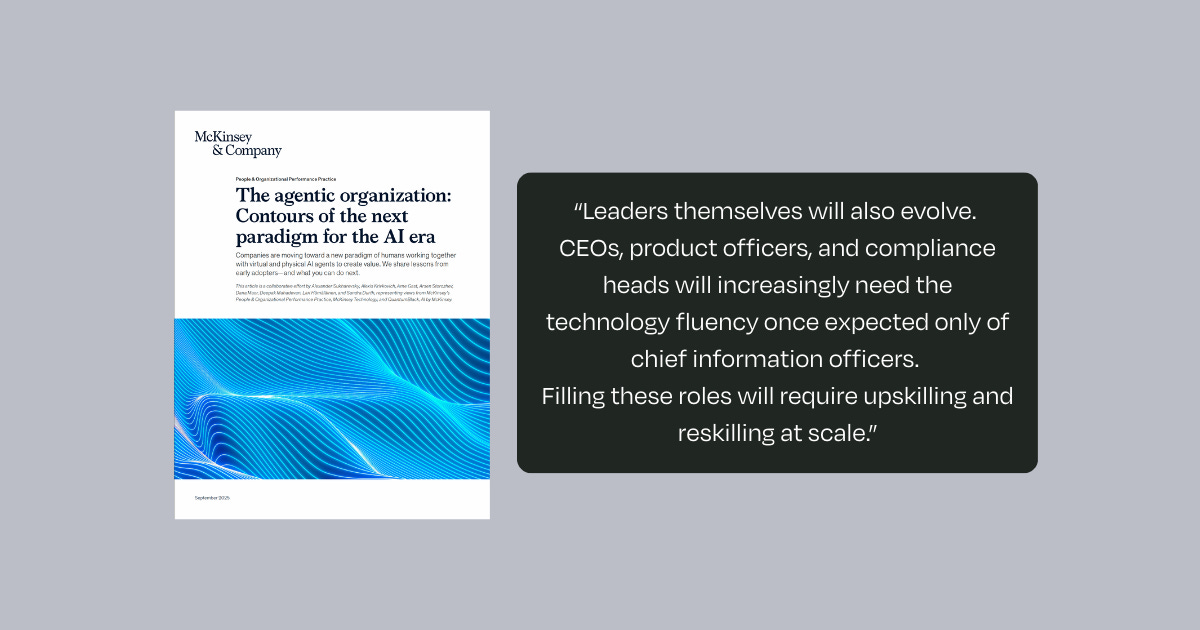
McKinsey published a whitepaper in September that should be required reading for every executive: “The Agentic Organization: Contours of the Next Paradigm for the AI Era.”
Buried on page seven is a line that deserves more attention than it’s getting:
“Leaders themselves will also evolve. CEOs, product officers, and compliance heads will increasingly need the technology fluency once expected only of chief information officers. Filling these roles will require upskilling and reskilling at scale.”
Read the full McKinsey report:

Here’s what McKinsey isn’t saying loudly enough: this isn’t about adding AI literacy to your leadership toolkit. It’s about fundamentally redefining what it means to be qualified for the C-suite.
After working with hundreds of executives in Berkeley’s AI program and hands-on cohorts I teach through Maven, I’ve seen exactly where this miscalibration shows up—and it starts with a single assumption that will disqualify leaders from the agentic era.
Most leaders underestimate the depth of technical fluency this actually demands. And I see evidence of that miscalibration every week.
The Calibration Problem
The assumption I hear most often sounds like this: “I’m a strategy person. I don’t need to understand the technical details.”
I encounter this regularly in the classroom. While I agree that certain technical details aren’t required for every leader to master, the broader assumption—that technical expertise isn’t necessary to lead successfully in the AI era—is dangerously wrong.
Leaders who believe AI expertise is something you delegate will not exist to lead in the era of agentic organizations.
McKinsey defines the agentic organization as: “This new paradigm unites humans and AI agents—both virtual and physical—to work side by side at scale at near-zero marginal cost.”
If you can’t engage directly with the technology that will define how your organization operates, you cannot credibly lead it.
Where I See This Playing Out
I often encounter entrepreneurs eager to jump into AI strategy or consulting who lack the years of hands-on experience in the craft. They underestimate that to be credible in front of a customer—to advise and drive an AI strategy—you must understand what the technology is actually capable of.
This isn’t about having an engineering or data science degree. It’s about something deeper.
Over the last few months, I’ve watched CEOs and SVP-level leaders engage with material I never expected them to touch. Most didn’t have technical backgrounds. Some held MBAs from Ivy League schools. What differentiated them wasn’t their credentials.
It was their curiosity. Their willingness to engage. Their courage to ask questions out loud.
I’ve seen leaders walk in with zero experience using AI code editors like Cursor or command-line tools like Claude Code. They left with hands-on expertise and an expanded vision of what’s possible.
When a leader walks in asking, “What is the terminal?” and walks out saying, “I love Claude Code in the terminal,” you’re witnessing the identity shift that leadership in the agentic organization demands.
A year ago, I would not have predicted that executives at this level would be engaging with AI technology this directly. But the ones who are thriving have embraced something the others resist: the willingness to be a beginner again.
The Identity Shift Leaders Must Make
Here’s what I’ve learned from watching hundreds of executives confront this challenge: the barrier isn’t intellectual. It’s psychological.
Many leaders have built entire careers on being the smartest person in the room. They’ve risen by having answers, not asking basic questions. The idea of sitting in a workshop and asking “what is the terminal?” feels like an admission of incompetence.
But that framing is exactly backward.
The leaders who will thrive in agentic organizations aren’t the ones who already know everything. They’re the ones brave enough to engage with curiosity—to ask questions out loud, to experiment with unfamiliar tools, and to model for their teams that continuous learning isn’t optional.
To inspire your employees to learn technical concepts, you must demonstrate that commitment yourself. You cannot delegate your way to credibility.
This requires leaders to confront deeply held beliefs about their identity:
“Technical work is for technical people.” In the agentic era, the line between strategy and execution dissolves. If you can’t understand how AI agents operate, you can’t architect the systems that will define your organization’s future.
“My job is to set direction, not get into the weeds.” The weeds are now strategic. Understanding what’s possible at the implementation level directly shapes what’s possible at the strategy level.
“I don’t have a technical background, so this isn’t my domain.” Neither did most of the executives who’ve transformed in the programs I teach. Background matters far less than willingness to engage.
The shift isn’t from “non-technical” to “technical.” It’s from “I delegate this” to “I must understand this to lead effectively.”
Here’s the good news: curiosity isn’t a credential. It doesn’t require a technical degree or decades of engineering experience. It requires one decision—to engage rather than delegate, to ask rather than assume, to experiment rather than observe.
I’ll be honest about my own calibration. I have two technical degrees and decades of hands-on experience, but I am not a hardcore developer. When I read articles or watch videos from skilled engineers and developers, it reminds me how much I still don’t know. Rather than discouraging me, it’s energizing. I see how far I’ve come in my technical skills, but also the opportunity and excitement to learn more.
Constant calibration and the thirst to learn keep me grounded in what I’m capable of and guide my learning plan. It’s my value of curiosity that powers my learning engine. That same engine is available to every leader willing to turn it on.
What Happens When Leaders Walk the Talk
I recently watched a five-person executive team at a mid-size energy technology firm do something I rarely see. After completing a hands-on AI program, they didn’t stop there. They continued their learning.
They built a culture and space for their employees to learn. They created a hands-on training program for over 70 people within their organization—walking the talk by demonstrating their commitment to helping employees start and accelerate their learning of AI technology and apply it to real workflows.
At the end of six weeks, they held an internal show-and-tell where employees demonstrated what they’d built. The creativity and energy in that room were remarkable. People who had never used AI tools showcased workflow automations they’d created themselves.
None of that happens if the executive team delegates their own learning. It started because five leaders engaged at a deeper level—asked the uncomfortable questions, got their hands dirty with the technology—and then committed to bringing that same experience to their organization.
This is the multiplier effect of hands-on leadership. When you model curiosity, you give your people permission to be curious. When you embrace being a beginner, you create psychological safety for others to do the same.
It’s the hands-on leaders who will build the agentic organizations of the future. Not because they become the most technical people in the room—but because they create cultures where technical learning is expected, supported, and celebrated.
Nothing Beats Getting Hands-On
Here’s the uncomfortable truth: you cannot read your way to technical fluency. You cannot delegate your way there. You cannot hire your way there.
You have to do the work yourself.
This is where I see leaders gain real insight into how much they don’t know—by navigating their file system, installing software, and running commands in the terminal. The friction is the teacher. The discomfort is the curriculum.
Learning by doing—focusing on a workflow that has potential to be automated or accelerated—is the only way to build the intuition that agentic leadership requires.
The Question You Need to Answer
McKinsey’s message deserves to land harder than a footnote in a whitepaper:
“CEOs, product officers, and compliance heads will increasingly need the technology fluency once expected only of chief information officers.”
This isn’t a future prediction. This is happening now. The executives I work with are already making this transition. The question is whether you will join them or be replaced by someone who does.
The gap between where you are and where you need to be isn’t closed by hiring smarter people or attending more conferences. It’s closed by curiosity—the willingness to ask “what is the terminal?” out loud and stay in the room long enough to find out.
What are you afraid of? Is it looking incompetent? Being exposed as someone who doesn’t understand the technology shaping your industry? Name the fear. It’s the first step to moving past it.
Do you have the technical foundation to lead an agentic organization? Not to build one yourself—but to understand it deeply enough to make strategic decisions, evaluate talent, and hold your teams accountable?
What identity are you holding onto that no longer serves you? “I’m a strategy person.” “I’m not technical.” “That’s what I hire people for.” Which of these beliefs is protecting your ego at the expense of your relevance?
What self-limiting belief must you reframe? The leaders who’ve transformed didn’t suddenly become engineers. They simply stopped telling themselves that technical engagement wasn’t for them.
The agentic era won’t wait for you to feel ready.
What would change if you stopped telling yourself that technical engagement isn’t for you?