


When leaders join my cohorts, the first session doesn’t automate anything. We start mapping how their business creates value.
I start there on purpose. An AI strategy can only be as good as your picture of the work. And AI is changing that work in every function at once, from sales and finance to delivery and support.
The leaders I’ve seen get results from AI know their work well enough to keep redesigning it as the tools improve.
What an AI-first mindset is
Here’s how I define it. An AI-first mindset is a habit. For every piece of work you do, you ask: if I were designing this today, knowing what AI can do, how would it run?
You start with the work and bring in the tool second. Keep asking, because the answer changes every time the models improve. A workflow you settled last quarter may deserve a fresh look this one.
Judgment stays with people. Some workflows will run on their own, and others you’ll work alongside. Either way, AI proposes, and you decide.
In practice, AI-first means every workflow gets a fair hearing, including the ones you’ve run the same way for years.
Start with the value chain
When I teach AI strategy to leaders at Berkeley Haas and in my cohorts, we start with the value chain, before any tool.
Michael Porter gave leaders the value chain in Competitive Advantage (1985). His insight was that competitive advantage lives in the specific activities a firm performs to design, sell, deliver, and support what it offers.
Porter sorted those activities into two groups. Primary activities create and deliver the offer, such as operations, marketing and sales, and service. Support activities make them possible: your people, technology, procurement, and the firm’s infrastructure. Each activity drives your costs or shapes the value a customer sees. The links between activities matter just as much.
That same year, Porter and Victor Millar wrote in Harvard Business Review that information technology was changing the value chain itself: how each activity gets done, and how the activities connect. AI is doing the same thing now, and it's reaching work that used to require a person, like research and first drafts.
That’s why AI strategy has to work at the level of activities. AI doesn’t transform “marketing.” It transforms how you research a prospect, draft a proposal, and review the pipeline on Monday morning.
Where AI advantage comes from
Porter drew another line that matters for every AI plan. In “What Is Strategy?” (HBR, 1996), he separated operational effectiveness from strategy.
Operational effectiveness means performing the same activities better than your rivals. You need it, and your competitors will copy it, so the gains don’t last. Strategy is a different kind of choice. In Porter’s words, “Competitive strategy is about being different. It means deliberately choosing a different set of activities to deliver a unique mix of value.”
When every firm buys the same models to speed up the same activities, everyone gets faster together. That’s operational effectiveness at scale, and no one pulls ahead.
Advantage comes from using AI to reshape your own value chain. You perform activities your rivals don’t, or you perform shared ones in a way that runs on your know-how. Porter called the way activities reinforce each other fit, and he argued fit is what makes a strategy hard to imitate. A competitor can buy the same AI. It can’t easily copy a whole system of workflows built around how your firm creates value.
Competitive advantage shows up in the P&L
In my cohorts, I put up a slide built on Joan Magretta’s Understanding Michael Porter, her guide to his work. In Porter’s framework, competitive advantage links three things: the value you create, how you create it (your value chain), and how you perform (your P&L).
Advantage shows up in the numbers. Compared with rivals, you run at a lower cost, charge a premium price, or both. Activities in your value chain drive both levers.
The other half of that slide comes from Felix Oberholzer-Gee’s Better, Simpler Strategy, and I find it especially useful for AI. He calls it the value stick:
Willingness to pay. The most a customer would pay. Raise it, and you create customer delight.
Price. What the customer actually pays. The gap between price and cost is your margin.
Cost. What you pay employees and suppliers.
Willingness to sell. The least an employee or supplier would accept. Lower it by improving the work, and you create employee satisfaction and supplier surplus.
The value a firm creates is the distance between willingness to pay and willingness to sell. You can widen it from either end. If you want to go deeper, Oberholzer-Gee lays out the value stick in his HBR article, “Eliminate Strategic Overload.”
So when I look at a workflow to reimagine with AI, I ask what it moves. Take proposal drafting. If AI cuts the first draft from a day to an hour, that lowers cost. If the hours saved go into tailoring the proposal to the client, that can raise what the client is willing to pay. If the person drafting spends less time on boilerplate and more on thinking, the work gets better too. If a workflow moves none of these, it’s activity, and it won’t show up in your results.
I tell the leaders in my cohorts the same thing every time: this isn’t a science project. We’re using AI to deliver outcomes in the P&L.
The map becomes a strategic canvas
It all starts with seeing your chain. What do you offer? Which processes deliver it? Inside each process, which workflows run, and in what order?
A process is an outcome your business delivers, like winning new clients. A workflow is one repeatable piece of work inside it, like researching a prospect before the first call.
Order matters more than it looks. When workflows follow the sequence the work actually happens in, you can see how value moves through the business, and where it gets stuck.
Once I could see my workflows that way, I could start making choices about them. I sort each one into a group:
Reimagine. Work that could run in a different way with AI. In my business, email triage, research, and first drafts all landed here.
Protect and deepen. Work where your judgment and relationships create the difference clients pay for. Aim AI at making the people who do this work better, and keep investing in them.
Hand off. Work that has to happen but doesn’t set you apart. Delegate it to a partner, a platform, or an agent, and keep your attention on the work that does. Porter put it plainly: “The essence of strategy is choosing what not to do.”
The map shows one more thing: gaps. A process with no workflows behind it is either work no one owns, or an opportunity waiting to be built.
You can’t safely hand off a workflow you haven’t mapped, because you can’t tell whether it’s core. The groups also shift. Work that’s core today can become routine as models improve, so the map must stay current.
This also changes the old build-or-buy question. You now answer it workflow by workflow: build what’s core to your know-how, buy what a platform already does well, and partner on the rest. You can only make those calls once you can see the workflows.
Your know-how lives in your workflows
Much of a firm’s intellectual property lives in how its people do the work: the first questions a senior consultant asks, or the checks a finance lead runs before anything leaves the building.
When that knowledge stays in someone’s head, no one else can improve it or build on it with AI. When that person leaves, it goes with them.
Once you name a workflow and link it to the outcome it serves, the firm keeps that know-how as an asset. Link it to the skills and agents that power it, and you can see where AI is doing work in your business, and why.
The method I teach: understand the work, then catalog it
In both of my cohort courses, Hands-on Agentic AI for Leaders and Agentic AI for Claude Builders, students map their work first. In the first session, they catalog it in what I call an AI Registry. They practice building skills and agents along the way, and the registry ties each one to the workflow it serves. By the last week, it records every workflow they built.
I run my own business the same way. My AI and I catalog every line of business, process, and workflow. As of this week, that’s 27 processes and 77 workflows, each with a status. Every workflow page links to its process and to the skills and agents behind it. I don’t write the pages by hand. My AI drafts them with me as the work happens, and I check that they say what I mean.
The registry is the page I open most days. When I start a new workflow on Claude, it first opens a registry page linked to the process it strengthens. When I ask my AI which workflow to design next, it follows those links and answers from my own chain of work. Without them, I’d get generic advice.
The work is the craft
I built every one of my workflows, and I still find it hard to remember them all. The registry keeps me close to them. Each time I open it, something catches my eye: a process with nothing behind it, or a skill I built that no workflow uses yet.
Understanding the work we do shapes our ability to get the outcomes we want, in business and in life. I believe we need to see, touch, and improve our workflows every day as we practice our craft. AI amplifies judgment, and that judgment comes from staying close to the work.
Start with the workflow that frustrates you most, or the one you’d struggle to explain to a new hire. Either is a good place to ask the AI-first question.
Try this (30 minutes). Pick one line of business. List its processes, then write the workflows inside one process in the order they run. Mark each one: reimagine, protect, or hand off. For each one you’d reimagine, note what it moves: willingness to pay, cost, or the work itself.
See my value chain, then build your own
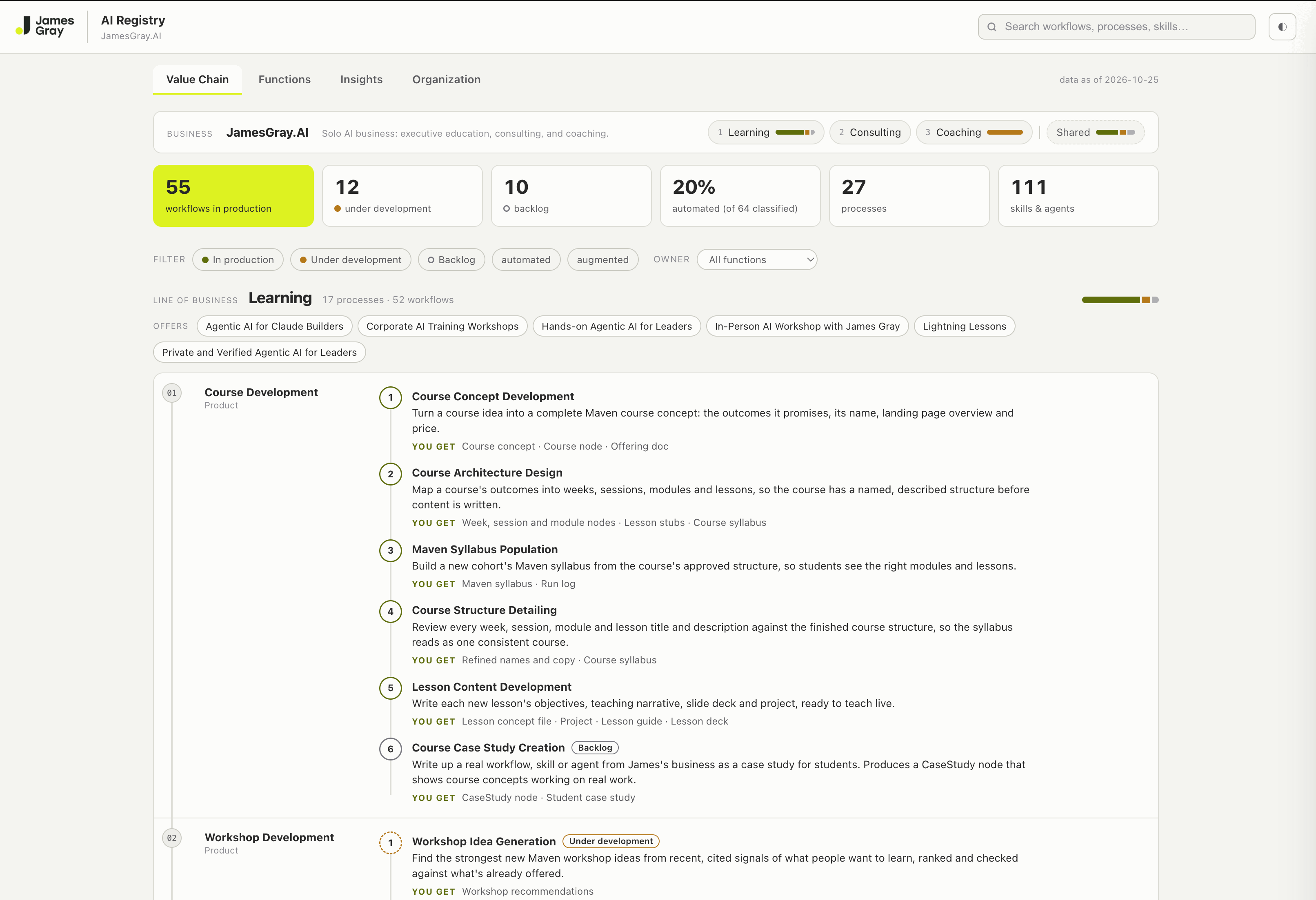
To see how this works in practice, I showed it in my latest Lightning Lesson, a free 45-minute live session on Maven: Map Every Workflow You Run on One Page. I open my AI Registry and walk through my business as a value chain. I trace one workflow up to the outcome it serves, then ask my AI which workflow to design next. Watch the recording →
If you’d like to go further with me, both of my cohort courses start Monday, November 9:
Hands-on Agentic AI for Leaders, cohort 21. Four weeks building the skills and agents behind your workflows on Claude, ChatGPT, M365 Copilot, or Gemini Enterprise.
Agentic AI for Claude Builders, cohort 8. Five weeks building the skills and agents behind your workflows on the Claude platform.
No matter where you start, the ideas are the same. An AI-first mindset starts with the work; the tool comes second. Every firm can buy the same models, so advantage comes from how AI reshapes your own value chain. And it has to show up in the P&L.
So map your processes and workflows. Decide what to reimagine, what to protect, and what to hand off. Then keep the map current as the models improve, because the right answers will change.
You don’t need a course to begin. The 30-minute exercise above is enough to start this week.
Stay curious. Stay hands-on.
James