


Most AI education gives you pieces. A prompting trick here. A tool demo there. Disconnected fragments that leave you with the same question you started with:
How do I actually go from my business process to a working AI system?
Over the next three weeks, I’m running three free Lightning Lessons on Maven that answer that question — start to finish.
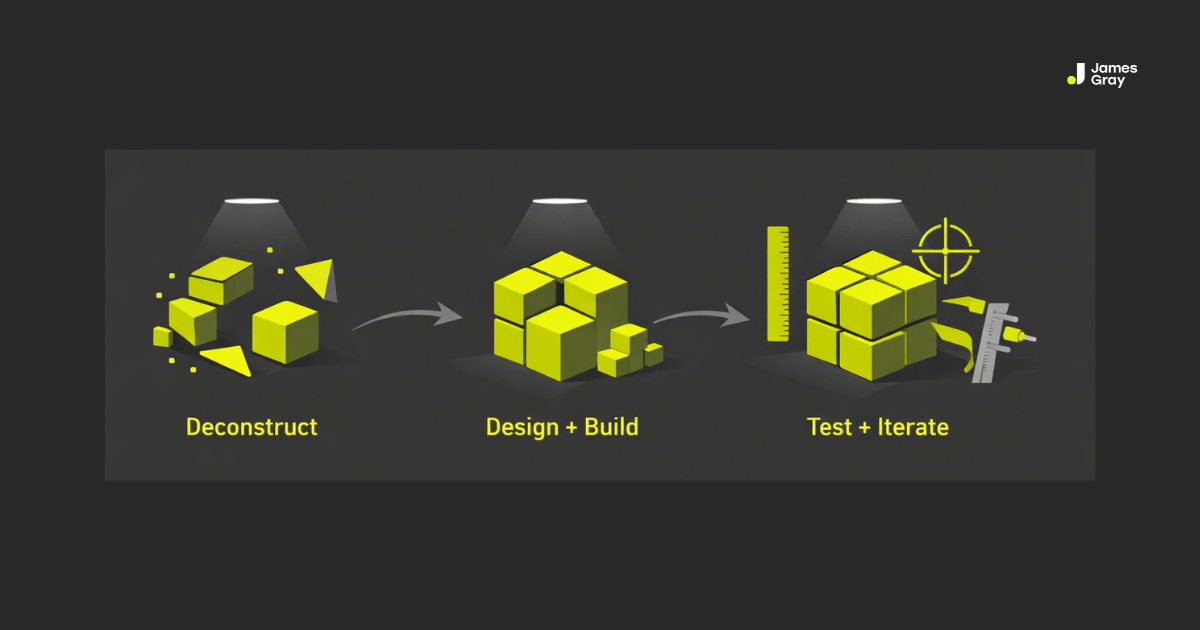
Each session is 30 minutes. Each one builds on the last. Together, they walk you through the Business-First AI Framework — the same 7-step methodology I teach in two cohort courses — from deconstructing a messy process to testing and iterating a production-ready AI workflow.
Here’s what’s coming.
Week 1: Deconstruct (Framework Step 2)
March 27 | 30 min | Free on Maven
Your 5-step process is actually 15 steps. You just can’t see them yet.
That’s the core insight of the Deconstruct phase. Most AI projects fail not because the technology breaks — but because the process wasn’t broken down enough for AI to execute reliably. Hidden decisions, implicit data handoffs, undocumented context needs, and failure modes only surface after you’ve built the wrong thing.
In this session, I’ll deconstruct a real business process live using a 5-question framework:
Discrete Steps — What are the actual sub-steps hiding inside each “step”?
Decision Points — Where does someone make a judgment call?
Data Flows — What goes in, what comes out, where does it come from?
Context Needs — What templates, docs, or references does each step require?
Failure Modes — What does bad output look like, and how would you catch it?
By the end, a simple-looking process becomes a fully mapped workflow definition — the kind of clarity AI actually needs to do useful work.
You’ll walk away with: A repeatable methodology you can apply to any process in your organization. No AI tools required — just sharper thinking about how work actually works.
Week 2: Design + Build (Framework Steps 3-4)
March 31 | 30 min | Free on Maven
You’ve deconstructed the process. Now what?
This session picks up where Week 1 leaves off. Starting from a workflow definition, I’ll walk through the Design and Build phases — live on Claude.
First, Design: you’ll see how each step in a deconstructed process maps to AI building blocks. Which steps become prompts, which become skills, which need agent orchestration, which require integrations. The design matrix classifies your workflow — deterministic, guided, or autonomous — and that classification constrains what you can build.
Then, Build: you’ll watch the actual construction. A workflow definition becoming executable artifacts in Claude Code, in real time. The definition drives every decision. You’re not guessing what to create — the Deconstruct output tells you exactly what artifacts you need.
The key insight: Build is step 4 of 7. Shipping the first version isn’t the finish line. Test and Improve are what turn a build into a production system — and that’s where we’re headed in Week 3.
You’ll walk away with: A clear mental model for turning any deconstructed process into a working AI system — and an understanding of what comes next to make it production-ready.
Week 3: Test + Iterate (Framework Steps 5 & 7)
April 3 | 30 min | Free on Maven
You’ve built the workflow. Now prove it works — and make it better.
This is where most people stop. They ship v1 and hope for the best. But the Business-First AI Framework has two more phases for a reason: Test verifies your build produces consistent, quality output across real scenarios. Improve optimizes for speed, cost, and reliability so the workflow actually gets used in production.
In this session, I’ll show both phases in action — using Claude skill configuration as the lens:
Structured evals (Test) — Run evaluations that verify your skills produce consistent output before you rely on them. Evals catch the inconsistencies that spot-checking misses.
Effort levels (Improve) — Control how deeply Claude thinks before responding. High for nuanced analysis, low for straightforward transformations. Match the compute to the job.
Model selection (Improve) — Match Opus, Sonnet, or Haiku to each skill based on the reasoning it requires. Not every skill needs the most powerful model.
The punchline: a well-configured skill on Haiku can outperform a poorly configured one on Opus. Testing tells you which configuration actually works. Iteration makes it cheaper and faster without sacrificing quality.
You’ll walk away with: An eval methodology to verify your builds work — and a configuration matrix for optimizing quality, speed, and cost across any Claude skill.
Why These Three Sessions Fit Together
This isn’t three random topics. It’s one framework:
Analyze → Deconstruct → Design → Build → Test → Run → Improve
That’s the Business-First AI Framework — the 7-step methodology I teach in my Maven courses and at Berkeley. These three Lightning Lessons cover the critical phases:
Week 1 (Deconstruct) exposes the real complexity in your process
Week 2 (Design + Build) turns that clarity into a working AI system
Week 3 (Test + Improve) proves the system works and makes it faster, cheaper, and more reliable
Most people skip straight to building. Then they wonder why the results are inconsistent. The reason is almost always the same: the process wasn’t broken down enough, or the system was never tested and tuned for the job.
These sessions give you the key phases in 30 minutes each. My Maven courses — Hands-on Agentic AI for Leaders and Claude for Builders — give you the full lifecycle with hands-on practice on your own workflows.
All Three Are Free. All Three Are Live.
Live demos, real processes, real builds. And if you can’t make it live, register anyway. You’ll get the recording and the slide deck after each session.
Register for any or all:
March 27: Deconstruct Any Business Process into an AI Workflow
April 3: Configure Claude Skills for Quality, Speed, and Cost
If you know someone who’s been trying to figure out how to go from business process to working AI, forward this to them. These three sessions cover the complete path.
Stay curious. Stay hands-on. 🙌
James
This is a strong structure, especially the Deconstruct → Build → Test loop. One thing that’s helped us keep this practical is adding a tiny “run receipt” after each workflow test: objective, key tool calls, failure observed, fix applied, and next test. That single habit made iteration speed and quality much easier to track across weeks.
If useful, we share concrete OpenClaw examples in that format here: https://substack.com/@givinglab